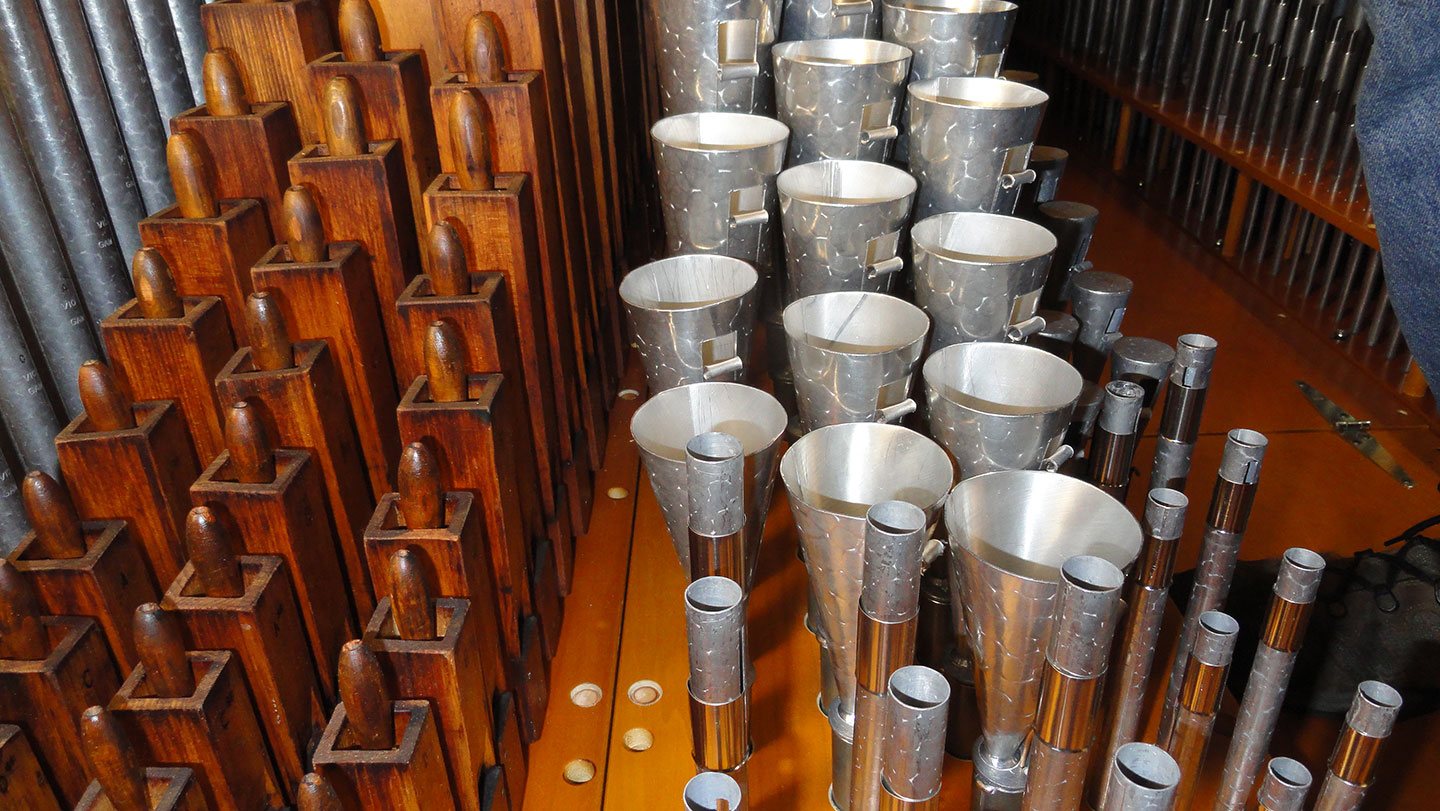
Reeds
include the following list of stop names and although
their tonal characters can be as different as night
and day, they are all members of the reed family
of pipes. Trumpet, Oboe, Clarinet, Clarion, Fagott,
Bombarde, Posaune, Tromba, Trombone, Tuba, Tuba
Mirabalis, Contra Trompette, Trompette, Hautbois,
Krummhorn, Schalmei, Rohr Schalmei, Regal, Vox Humana,
Bassoon, Flugel Horn, Cor Anglais, French Horn,
Orchestral Oboe, Mussette, Dulzian, Trumpet Enchamade,
Chalameu, Ophicleide, Festival Trumpet.
Reeds belong to the family of beating reeds
and produce their tone differently than the flue
families as described in previous issues. Reed tone
is produced by the beating of a brass reed tongue,
which is held tightly against the brass shallot.
Wind pressure from the windchest sets the reed into
motion. Once the tone is produced by this motor,
it is further reinforced, colored and tuned by the
resonator. This resonator can be of
various shapes and sizes. Labial Reeds are the classification
of pipes that produce imitative reed tone without
the vibrating reed tongue. This tone is produced
by flues pipes that have been voiced to emphasize
spedific harmonic characteristics to appear to resemble
a reed pipe. (Labial Oboe, Saxophone).
The reed tongue is nothing more than
a flat, thin, springy piece of brass. The shallot
is also made of brass but is more like a hollow
tube, which is closed at one end. One face of the
shallot is perfectly flat and the hollow center
appears on this face as a slot. This slot can be
either tapered (like a trapezoid) or straight (rectangle).
Both the shallot and the tongue are held firmly
into the block by the wedge.
The wedge can be wooden or made of brass. A tuning
wire also passes through the block. This
wire is bent in such a way as to apply pressure
at the appropriate spot on the reed tongue to produce
the desired tuned pitch. By gently tapping the wire
up or down, the pitch is determined by the length
of the vibrating part of the reed. The block, is
cast from lead, and is the part of the pipe that
holds the tongue, shallot (secured by the wedge)
and the wire. The resonator is soldered onto the
block, which is then set into the boot. Just
as its name implies, the boot acts as the pipe foot.
When the reed tongue is pressed against the flat
face of the shallot an air seal is produced. Conversely
when the tongue is allowed to spring back, air can
flow into the shallot once more. This alternating
pattern produces a raw sound wave. The reed tongue
must be curved precisely to produce a pleasing tone.
When properly curved, the tongue will roll down
the shallot as it covers the opening creating a
round, musical sound. If the tongue is improperly
curved it will beat against the shallot and produce
a harsh, unmusical noise or may make no sound at
all.
Reed tongues are of varying lengths and thickness
(according to the wind pressure and desired tone).
Larger varieties such as those of 8', 16' or 32'
pitches employ a small weight applied to the tip
of the tongue to introduce mass in order to "quicken"
the starting of these larger pipes.
Reeds are very sensitive to dirt. The smallest particle
of dust between the reed tongue and the shallot
can render a pipe silent or cause it to fly "off
speech". Dirty reeds have to be disassembled
and cleaned, then reassembled and tuned. A loose
wedge can also cause similiar problems. Once again
the pipe needs to be disassembled and the wedge
tightened.
Reeds can be tuned either on the wire, or at the
top. Most reed pipe resonators are slotted at the
top and utilize the metal cut from the slot as a
tuning scroll. Tuning reeds in this manner (at the
top) is the preferred method over tuning on the
wire. The reason for this is that tuning the reeds
on the wire shortens or lengthens the vibrating
toungue thereby changing the volume and color of
the note. In fact, this is how the tuner regulates
the reeds. Reed voicing and regulation can be a
bit time-consuming but the result is a beautifully
even sound throughout the compass of the stop. Melodies
sing when played on a well-voiced and regulated
solo reed and the sound of the ensemble is enlivened
by the controlled "fire" which the reeds
can add.
Reed pipes, like other pipes, can last for generations.
With care and judicious tuning the resonators will
remain straight and the scrolls will stay tight.
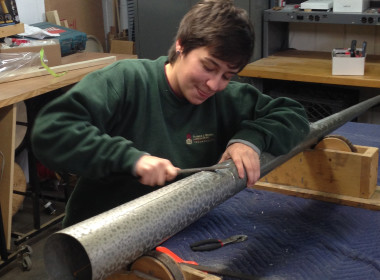
However, over the years reeds can show the scars
of time. Resonators become dented or bent, and scrolls
can break or become loose. Pipe bodies can separate
from the block or split at the rear seam. All of
these conditions harm the sound and make tuning
difficult. Broken pipes need attention and should
be repaired. Loose scrolls can make accurate tuning
a chore and also produce unwanted rattles.
We at Patrick J. Murphy & Assoc. are ready and
able to take care of your reeds. From routine tuning
and regulation, to straightening, cleaning and repairing,
our knowledgeable and experienced staff are uniquely
equipped to serve you.
|
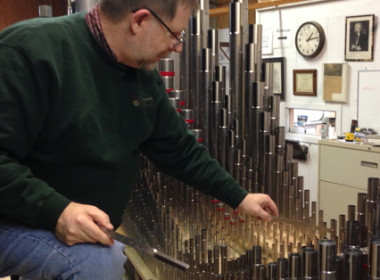
Voicing
Room Specimen Pipes
|
|
 |
A
rack of Reed pipes photographed in a voicing
room. This set of pipes, always in front of
the voicer, helps him to adjust and tune new
pipes to the standard of these pipes.
All speak from the middle C key. |
|
From
the left: English Horn 16', Fagotto 16',
Rankett 16', Trompette 8', Trompette
(smaller scale) 8', Trompette (shallot variation
8',
Clarinet 8', Krummhorn 8', Vox Humana 8',
Hautbois 4', Rohrschalmei 4', Fagotto (short)
4'
|
|
|